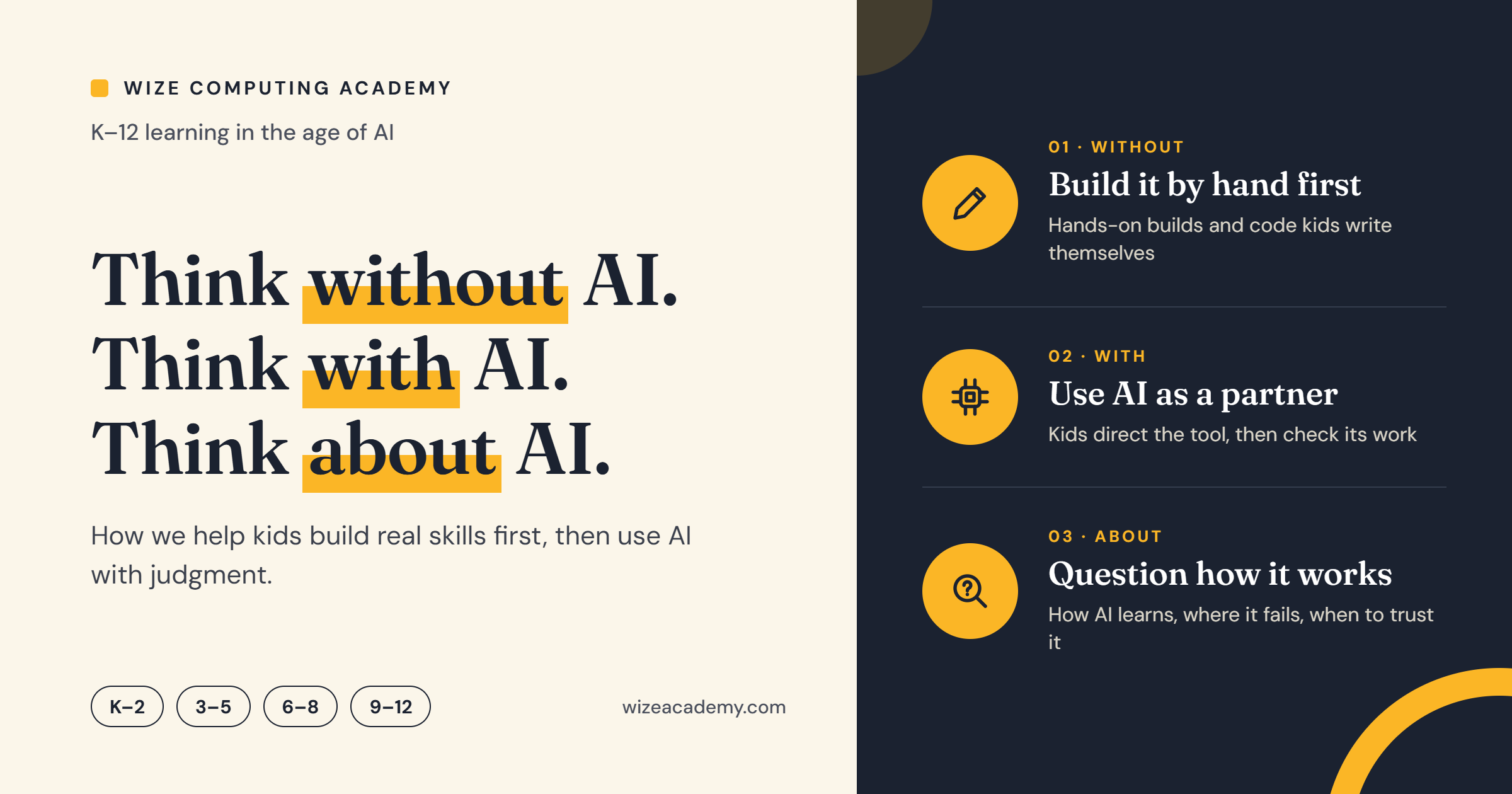
We don't just teach kids to use AI — we teach them to understand it, question it, build with it, and shape it responsibly. From ages 6 to 18, our three-layer pathway takes students from first awareness to confident creation.
Our AI curriculum isn't a bolt-on module. It's built on a philosophy that guides every project, every tool choice, and every classroom moment.
Students understand what AI is, why it matters, and how it impacts them before they write a single line of code. Coding is a tool, not the goal. Understanding comes first — always.
Responsible AI use isn't a standalone lesson — it's woven into every project. From the youngest learners asking "Is that fair?" to advanced students auditing real AI systems for bias.
Students are makers, not just users. They train ML models, build chatbots, generate media, audit AI products, and present their work. Every project ends with something the student created.
Three progressive layers that match how children actually develop as thinkers and creators. Students don't skip layers — they grow through them.
Ages 6–9 · Grades 1–3
"I can recognize AI around me and understand what it does."
Students discover AI in voice assistants, face filters, and smart toys. Through play-based activities, they learn to recognize AI, question how it works, and understand that AI learns from data — not magic.
Ages 9–12 · Grades 4–6
"I understand how AI learns and I can train my own models."
Students train real machine learning classifiers, explore how data quality affects results, identify bias, and build decision trees. They follow the 7 Steps of ML used by professional data scientists.
Ages 12–18 · Grades 7–12
"I can build AI-powered projects and think critically about AI."
Students build chatbots, design games with AI opponents, conduct algorithmic bias audits, create content with generative AI, and debate AI policy. Every project mirrors real industry practice.
Five Big Ideas in AI, revisited at every layer with increasing depth. A concept introduced through play in Layer 1 is explored through experimentation in Layer 2 and applied through creation in Layer 3.
Talk to voice assistants; explore face filters; identify sensors
Train image, sound & pose classifiers; understand how AI "sees"
Build voice skills; computer vision; deploy models in real apps
Sort objects; play 20 Questions; draw simple decision trees
Build decision trees; explore search algorithms & game strategy
Design knowledge systems; build chatbots; write algorithms
AI learns from examples, not rules; see pattern learning in action
Train ML models; distinguish supervised, unsupervised & reinforcement
Write reward functions; experiment with neural networks; tune performance
Talk to voice assistants; discover they sometimes misunderstand
Build sound classifiers; explore NLP basics & translation
Build voice skills & chatbots; master prompt engineering
"Can a computer be a friend?" Simple ethics conversations
Bias exercises with real AI; "Design a Fair AI" activities
Algorithmic bias audits; deepfake analysis; AI policy debates
We live in an AI-powered world that is rapidly changing the way we work and live. Every job function will be affected by AI in the near future, if not already.
According to McKinsey Global Institute:
400-800 Million jobs will be displaced worldwide by 2030
555-890 Million new jobs will be created by 2030
How AI is Transforming the Future Why Kids Need to Learn AI Today
Build Smart Chatbots, Self-Driving Models & More. Explore generative AI-Powered Creativity in Storytelling & Video Production
Develop Problem-Solving and Critical Thinking Skills Learn AI Tools Used by Industry Experts
Students will explore industry-leading AI tools to create stunning visuals, dynamic designs, and AI-powered animations. They will learn how to: Use various tools for AI-generated images and creative design. Leverage features to create engaging graphics and presentations. Experiment with industry-leading tools for AI-powered video editing and motion graphics.
Students will work in teams to brainstorm, create, and present AI-powered projects, fostering: Collaboration and leadership skills through group activities. Real-world teamwork experience using AI tools to complete creative challenges. Peer feedback and improvement, learning from each other’s strengths and ideas.
This program blends AI with storytelling and digital creativity, allowing students to: Develop original AI-generated comic books, short stories, and interactive narratives. Use AI to enhance scriptwriting, character design, and scene creation. Integrate voiceovers, animations, and AI-driven effects to bring stories to life.
This program goes beyond AI by helping students hone essential 21st-century skills: Art & Design: Using AI to enhance digital artwork and creative visuals. Technology & Coding: Understanding AI-driven automation and programming basics. Writing & Content Creation: Developing AI-enhanced narratives, scripts, and storytelling techniques. Public Speaking & Presentation: Showcasing their work in front of an audience with confidence.
We are committed to keeping you informed and up-to-date with the most recent updates from our programs and initiatives. From exciting new courses and workshops to special events and achievements!