Think Without It, With It, and About It: How We Prepare K–12 Students for a World Full of AI
By Vishal Bhasin, Co-founder, Wize Computing Academy
Parents ask us some version of the same question almost every week: should my child be using AI, or should we keep them away from it?
Our answer is both, in the right order.
That idea got a strong endorsement in a September 2026 Wall Street Journal from an unexpected place. In a WSJ essay, University of Chicago President Paul Alivisatos described how his university is reshaping its core curriculum for an AI world. At the center is a principle that every student should learn to “think both with and without machines.” UChicago will require writing courses done entirely without machine help. It is also moving toward a computational thinking requirement, so students can reason about how data and algorithms shape what we know. Its law school starts first-year students without AI and brings it in deliberately in later years. The goal is graduates who are ethical, skeptical and ambitious about the role AI plays in their lives.
What struck us most was the sequencing: build a strong human foundation first, then add the tools. We’ve been working toward the same idea in K–12, and we’d argue it matters even more for younger students. By the time a student reaches college, their habits for approaching a hard problem are largely set. Those habits form in elementary and middle school.
Our three commitments
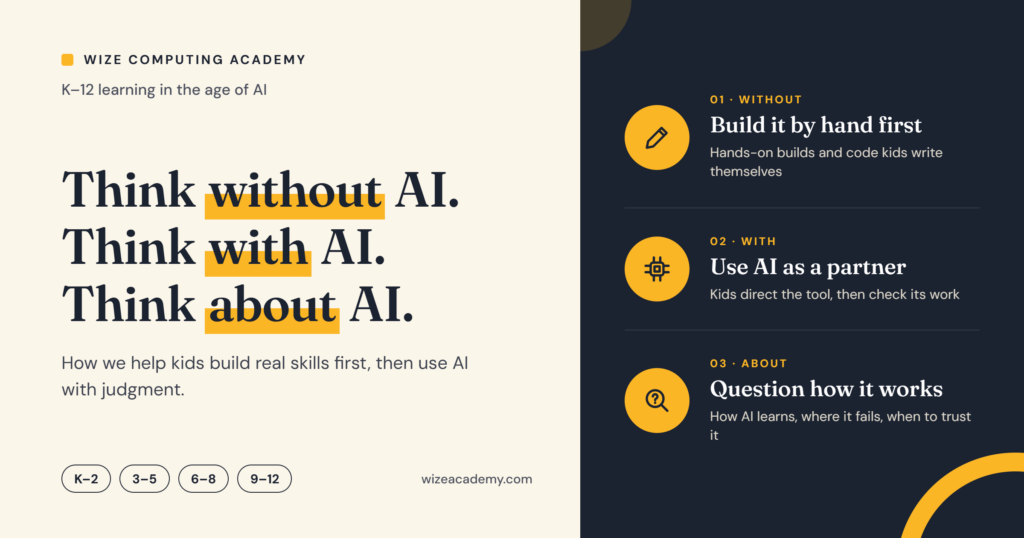
Think without AI. Real understanding comes from struggle: the blank page, the build that falls apart, the program that won’t run. In our afterschool clubs, elementary students build things like craft-stick grabber arms, cardboard robot hands that move with tendons, and magnet-powered cars. Our youngest learners assemble 3D shapes face by face with 3D pens. In ScratchJr, Scratch and Python, students write and debug their own code. When something doesn’t work, finding out why is the lesson, and no tool should take that moment away from them.
Think about AI. Before kids lean on AI, we want them to understand what it actually is. With tools like Teachable Machine and Machine Learning for Kids, students train their own simple models and see for themselves that an AI only knows what its examples taught it. Give it lopsided or sloppy examples, and it gives lopsided, sloppy answers. That experience turns “the computer said so” into “how does it know that?”, which is the most important question a young person can learn to ask.
Think with AI. Once that foundation is in place, AI becomes a powerful creative partner. In camps like AI Game Masters and AI Content Creators, and in projects like building voice apps with Alexa Blueprints, students use AI to make things they couldn’t make alone. The rule stays the same: students direct the tool, check its work, and own the ideas and judgment.
These commitments sit within our AI Pathway Framework, which moves students through AI Discovery, AI Thinking and AI Creation and is aligned with the AI4K12 and CSTA standards.
Why the order matters
A calculator is a wonderful tool for a student who already understands arithmetic, and a crutch for one who doesn’t. AI works the same way, only more so, because it can write, design, and explain, not just compute. A child who has debugged their own code can tell when AI-generated code is wrong. A child who has never done it can’t.
That’s why our youngest students spend most of their time building, making and reasoning with their own hands and minds. As students grow, AI enters gradually: first as something to understand, then as something to use. By middle and high school, we want students who can use AI fluently and explain what it got wrong.
Three things parents can try at home
Ask your child to explain their thinking before they ask a chatbot. Even a rough first attempt builds the muscle.
When they do use AI, challenge them to find one mistake or weak spot in its answer. Checking AI is a skill, and it’s fun to practice.
Keep making things together. Cardboard, tape, LEGO, a recipe, a birdhouse: the frustration of building something real is where confidence comes from.
The goal
We don’t want kids who avoid AI, and we don’t want kids who can’t function without it. We want kids who can think well either way and know which way a problem calls for. If a leading university is redesigning its curriculum around that idea, it’s worth starting at age five.
Want to see this approach in action? Book a free trial class at wizeacademy.com/free-trial.
Source: Paul Alivisatos, “Teach Students to Think With, Without and About AI,” The Wall Street Journal, Sept. 20, 2026.